About the artist
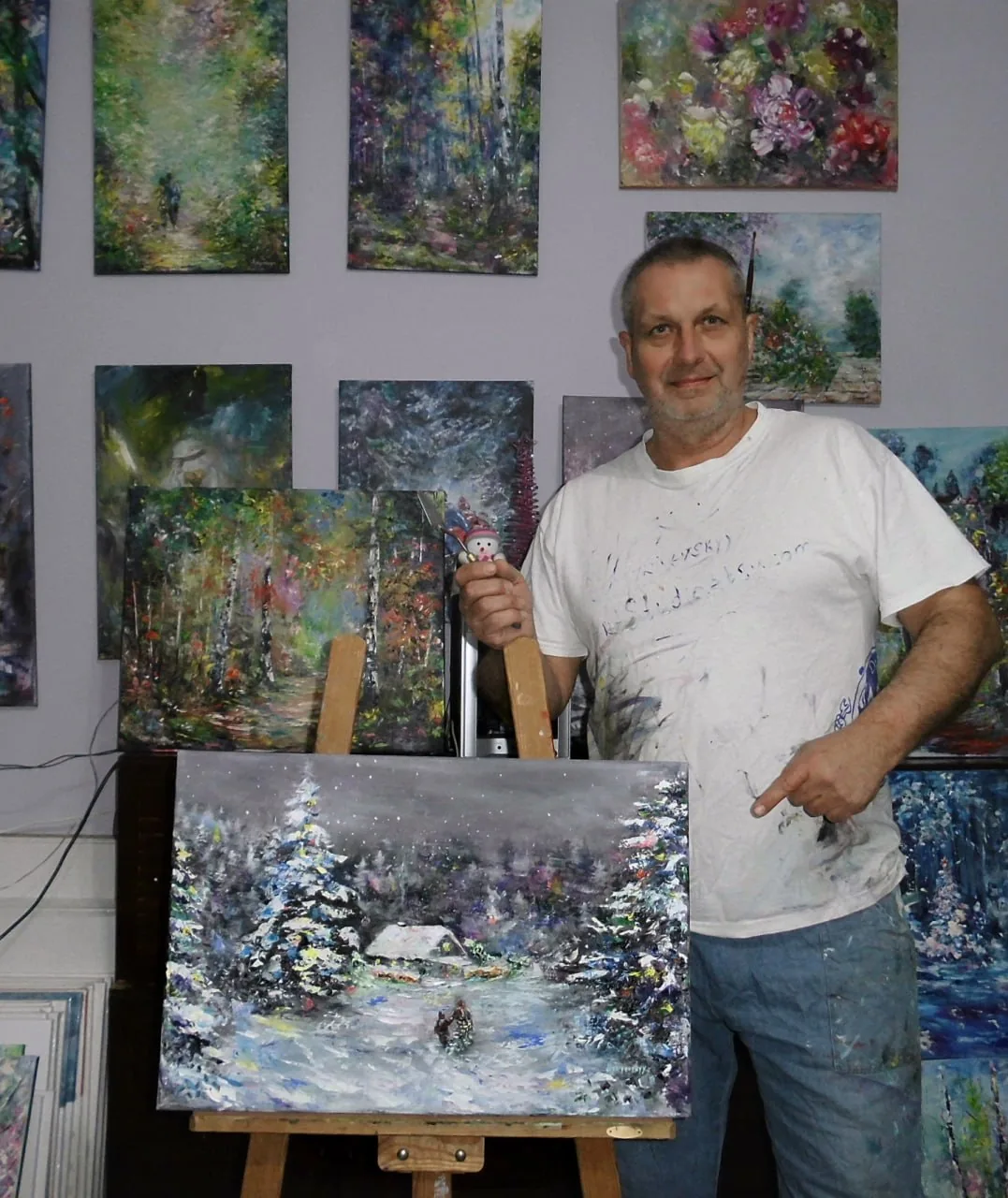
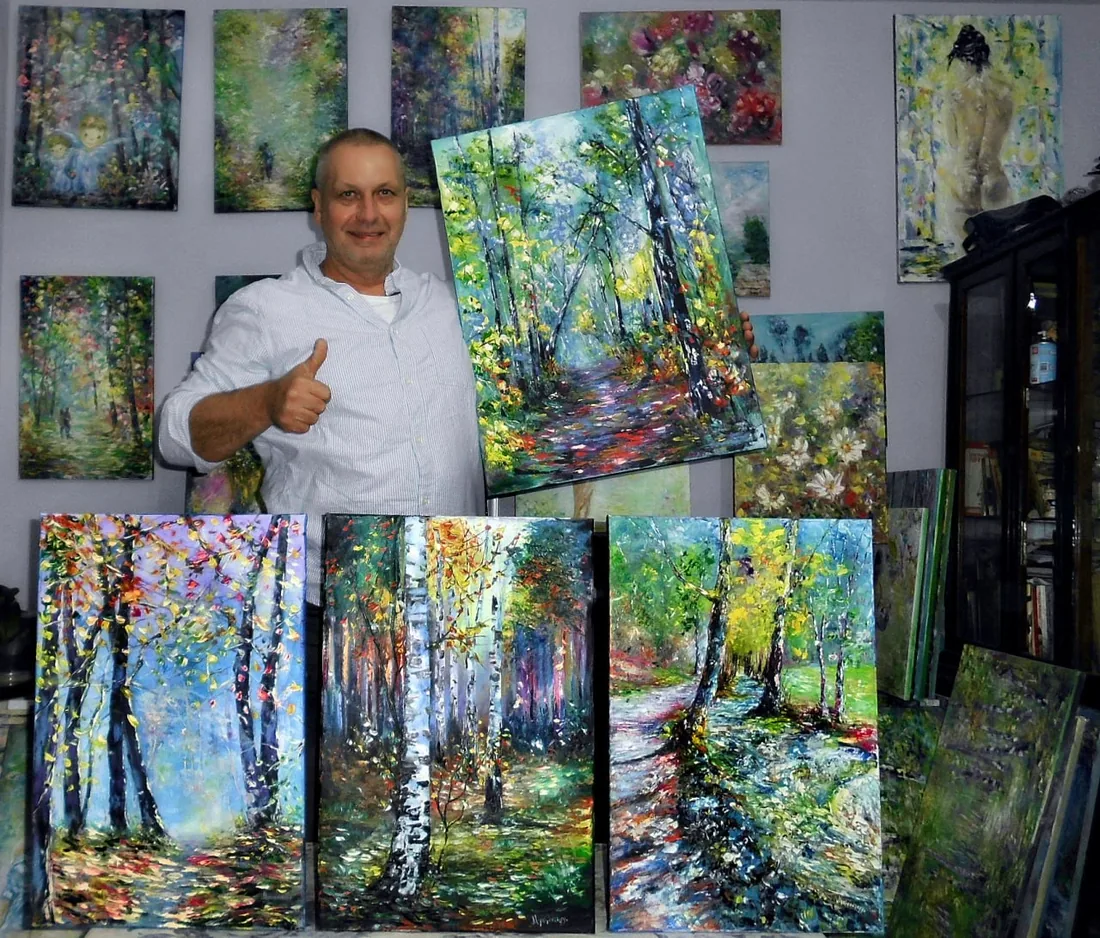
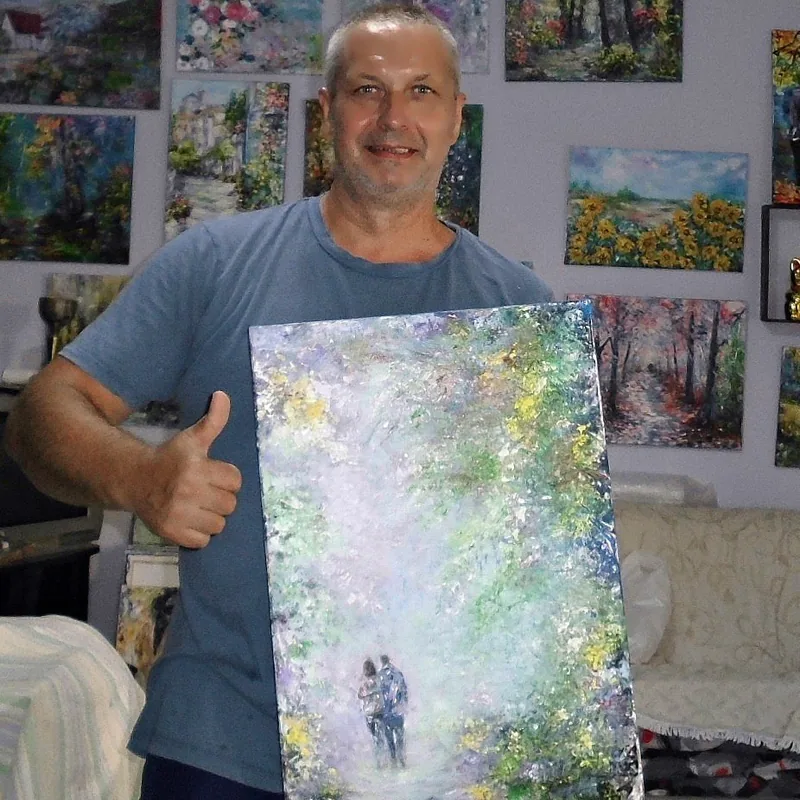
Volodymyr Myriyevskyy
I am a Ukrainian impressionist painter. I work in oil, with palette knives and brushes, from my studio on the Spanish Mediterranean coast — and I sell what I paint directly from here, without a gallery in between. Since 2015 more than 800 of my paintings have gone to collectors in 42 countries.
- Nationality
- Ukrainian
- Works from
- La Ràpita, Tarragona — Spanish Mediterranean coast
- Medium
- Oil on gallery-stretched canvas, palette knives and brushes
- Style
- Impressionism, worked thickly — impasto
- Subjects
- Forests, landscapes, flowers, seascapes and sailing ships, romantic couples, winter, fantasy and sacred subjects
- Selling since
- 2015
- Collected in
- 445 cities across 42 countries
- Languages
- English, Spanish, Ukrainian, Russian
- Contact
- contact@myriyevskyy.com
How I paint
Almost everything I make is built with a palette knife over brushwork. A brush pulls thinned paint into the weave of the canvas; a knife places thick, near-neat paint on it and leaves the edge of the blade behind. The surface ends up standing two or three millimetres off the fabric, so it catches light from the side and changes as you walk past it. That is the part a photograph cannot carry, and it is the reason collectors so often write that the colours are better in person than on the screen.
It also changes the colour itself. Mixing two pigments with a brush always produces a third that is duller than either parent — mixing subtracts light. When the knife lays a slab of yellow straight beside a slab of blue and leaves them alone, the mixing happens in your eye instead of on the palette, and the green that results stays bright. That is impressionism doing what it was invented to do, and it is why a forest of mine reads as green from across the room and dissolves into unmixed strokes of turquoise, violet and red when you stand close.
The knife is not good at everything, and it would be dishonest to pretend otherwise: it cannot do a fine line, a soft gradient or a face, and it cannot be corrected — lift a knife mark and everything underneath comes with it. So brushes do the structure, the edges and the detail, and the knife does the parts that should carry light: foliage, water, snow, sky, reflections.
What I paint
The forest is where most of the work happens: birch groves with the light coming through sideways, autumn paths buried in leaves, the same clearing under snow. I keep going back because the light is never twice the same. Around that there are seascapes and historical sailing ships, flowers, romantic couples, winter scenes, cityscapes, fantasy compositions and sacred subjects.
I do not paint from a formula and I do not repeat a picture that sold well. Each canvas is worked once, in my own emotional impressionist style, and then it is gone.
Forests · Landscapes · Flowers · Seascapes & ships · Romantic couples · Winter · Fantasy & mystical
One of a kind, and why that matters
Every painting offered here is an original oil on canvas, painted entirely by hand, existing in a quantity of exactly one. I never paint the same picture twice and no work is ever repeated as a second canvas — which is also why each one can only be sold once, and why a painting can disappear from the shop between one visit and the next.
- Signed on the front, and signed and dated on the back.
- A certificate of authenticity made out in the owner's name travels with the painting. If it is a gift, it can be made out to whoever is receiving it.
- Painted on gallery-stretched canvas over a wooden frame, ready to hang. It ships stretched, never rolled.
I also make fine art prints of my own paintings on request, on archival paper. A print is always described and sold as a print, on its own page and at its own price — never as an original. If you want to be able to tell the two apart anywhere online, not only here, I wrote down the seven tests I would use myself.
Where the paintings are
Since 2015 more than 800 originals have left this studio for private collections in 445 cities across 42 countries — including that of Chevalier Tony Clark, an American art consultant, curator and collector based in Los Angeles. Collectors have left more than 190 reviews, averaging 4.9 out of 5; the things they mention without being asked are the colours, the packing, and the handwritten note that goes in every box.
Buying directly from the studio
There is no gallery between us. You are reading the site of the person who painted the pictures, and the email address on it reaches me, not an assistant. That has practical consequences worth knowing:
- The price is the painter's price. A gallery typically takes between 30 % and 50 % of what a collector pays. Here, what you pay goes into the work and the shipping.
- You can ask the painter. What the surface is like, whether it fits your wall, how a colour behaves in evening light — write and you get an answer from the person who mixed the paint.
- Shipping is free to the European Union and the United Kingdom, and a flat, insured rate elsewhere, shown before you pay. Every painting is packed to gallery standards and travels stretched on its frame.
- Fourteen days to change your mind on any catalogue purchase, as EU consumer law provides. Commissions are the standard exception, because a painting of your house cannot be sold to anyone else.
Payment is handled by Stripe on its own secure pages — card, Apple Pay or Google Pay. I never see or store card details.
Commissions
I take on custom paintings: a place that matters to somebody, a larger version of an existing painting in a different palette, a different ship, a different fantasy scene. Most commissions start as an email that begins "I don't know if this is possible, but…", and most of them are. What does not work is a copy of another living artist's painting, or a photorealistic portrait — that is not this style, and saying so early is more useful than trying and disappointing you.
Writing from the studio
The journal is where I answer, once and properly, the questions that arrive by email over and over: how high to hang a painting and what size to buy, how to tell an original from a print, what shipping and customs actually cost, how a canvas is packed to cross an ocean, and how to look after an oil painting at home. It is written from this studio's own numbers rather than copied from anywhere.
Get in touch
Every message is read and answered personally, in English, Spanish, Ukrainian or Russian.