What a palette knife does that a brush cannot
By Volodymyr Myriyevskyy · 7 August 2026 · 5 min read
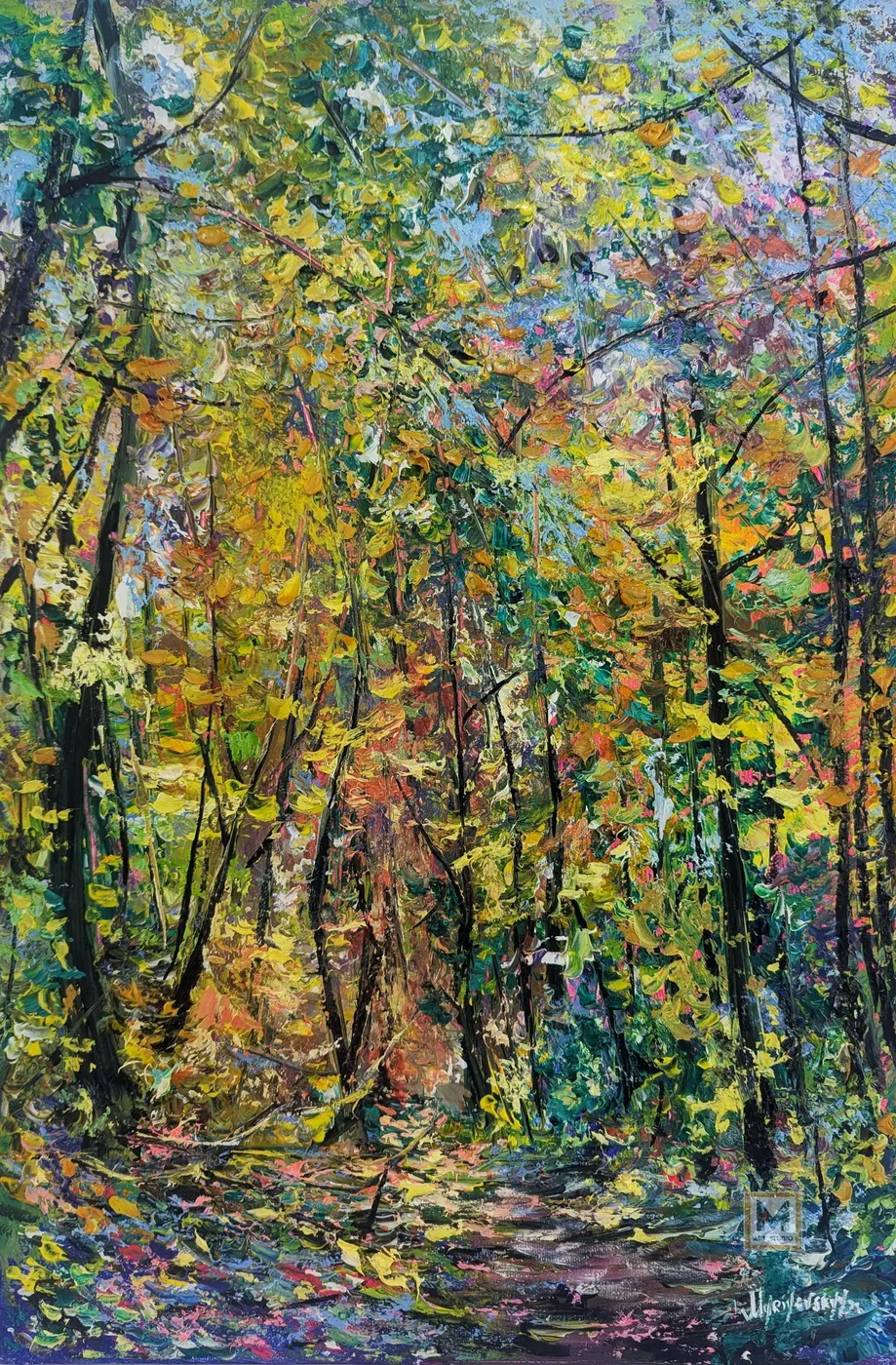
A brush pulls paint into the weave of the canvas; a palette knife lays it on top in slabs. That single difference gives the surface physical relief — ridges that catch light and cast small shadows — so the painting changes as the light in the room moves, which a flat surface cannot do.
People often ask why the paintings look different in person than in the photographs. The answer is not photography. It is that a knife-built surface has a third dimension, and a photograph has two.
Two tools, two completely different acts
A brush is a bundle of hairs holding thinned paint, and using it is a pulling motion: the paint is dragged across the surface and pushed down into the weave of the canvas. Control is high, blending is easy, and the result sits in the fabric.
A palette knife is a flexible steel blade. It picks up paint straight from the palette, largely undiluted, and puts it down in one pass. It is a placing motion, not a pulling one. The paint sits on the canvas, and it keeps the shape of the edge that left it.
| Brush | Palette knife | |
|---|---|---|
| Motion | pulls and drags | places and lifts |
| Paint | thinned, blendable | thick, near-neat from the tube |
| Surface | flat, in the weave | relief, up to several millimetres |
| Colour mixing | on the palette, then blended | often on the canvas, staying separate |
| Correction | easy while wet | very hard — the mark is the mark |
| Best at | detail, faces, gradients | light, foliage, water, snow, energy |
Why the colours look brighter
This is the part that surprises people most. When you blend two colours with a brush, you get a third, and that third is always slightly duller than either parent — mixing paint subtracts light. When a knife puts a slab of yellow directly beside a slab of blue and leaves them unmixed, your eye does the combining from a distance while each individual mark stays at full saturation.
That is straight out of impressionism, and it is why a knife-painted forest can read as green from across the room while, up close, it is made of unmixed yellow, turquoise, red and violet marks sitting next to each other. Walk towards it and it dissolves into its components; step back and it reassembles.
Why the light in your room matters so much
A ridge of paint standing two or three millimetres off the canvas has a lit side and a shadow side. Move the light — or move yourself — and both change. A painting like this is genuinely different at nine in the morning and at eight in the evening, and different again under a lamp.
This has a practical consequence when you hang it. Light coming across the surface at an angle rakes the texture and shows it. Light straight on flattens it into something close to a photograph of itself. If you own a heavily textured canvas and it looks disappointingly flat on your wall, the painting is almost never the problem: the lighting is.
His artworks carry an intense mysterious energy. I'm obsessed with it because it resonates with me deeply. I bought 6 artworks in the last years!
What the knife is bad at
It is worth being honest about the limits, because they explain why almost no painter uses only a knife. A blade cannot do a small precise line, a soft gradient, or a face. It cannot be corrected — remove a knife mark and you take everything underneath with it, so the choice has to be right the first time. And it uses a great deal of paint.
So most of the work here is both: knife for the parts that should carry light and energy — foliage, water, snow, skies, reflections — and brushes for structure, edges and detail. The two tools are not rivals; they answer different questions.
How to look at an impasto painting
- Stand close enough to see individual marks, then walk backwards until they fuse. Somewhere in between is where the painting is doing its work.
- Move sideways and watch the highlights travel across the ridges.
- Look at where the paint is thickest — that is usually where the light source in the picture is, because that is where the painter wanted the real light to catch.
- Look at the edges of the canvas: on a knife-built painting the paint normally runs over the sides, because the painter was working rather than composing a border.
Questions people ask
What is palette knife painting?
A technique where oil paint is applied with a flexible steel blade instead of a brush. The paint is laid on top of the canvas in thick slabs rather than pulled into the weave, giving the surface physical relief.
What is impasto?
Impasto is paint applied thickly enough to stand off the surface and hold the mark of the tool that laid it. It catches light on its ridges and casts small shadows, so the painting changes as the light moves.
Why do palette knife paintings look brighter?
Because the colours are not blended into each other. Mixing paint always dulls it slightly; leaving unmixed slabs side by side lets each mark stay at full saturation while the eye combines them from a distance.
How should a textured painting be lit?
From an angle, roughly 30° to the wall, so the light rakes across the surface and reveals the relief. Light aimed straight at the canvas flattens the texture.
I paint these in my own studio on the Spanish Mediterranean coast. Every painting is a one-of-a-kind original oil on canvas — signed, with a certificate of authenticity in your name, shipped stretched and insured.
See the paintings