How to tell an original painting from a print
By Volodymyr Myriyevskyy · 7 August 2026 · 5 min read
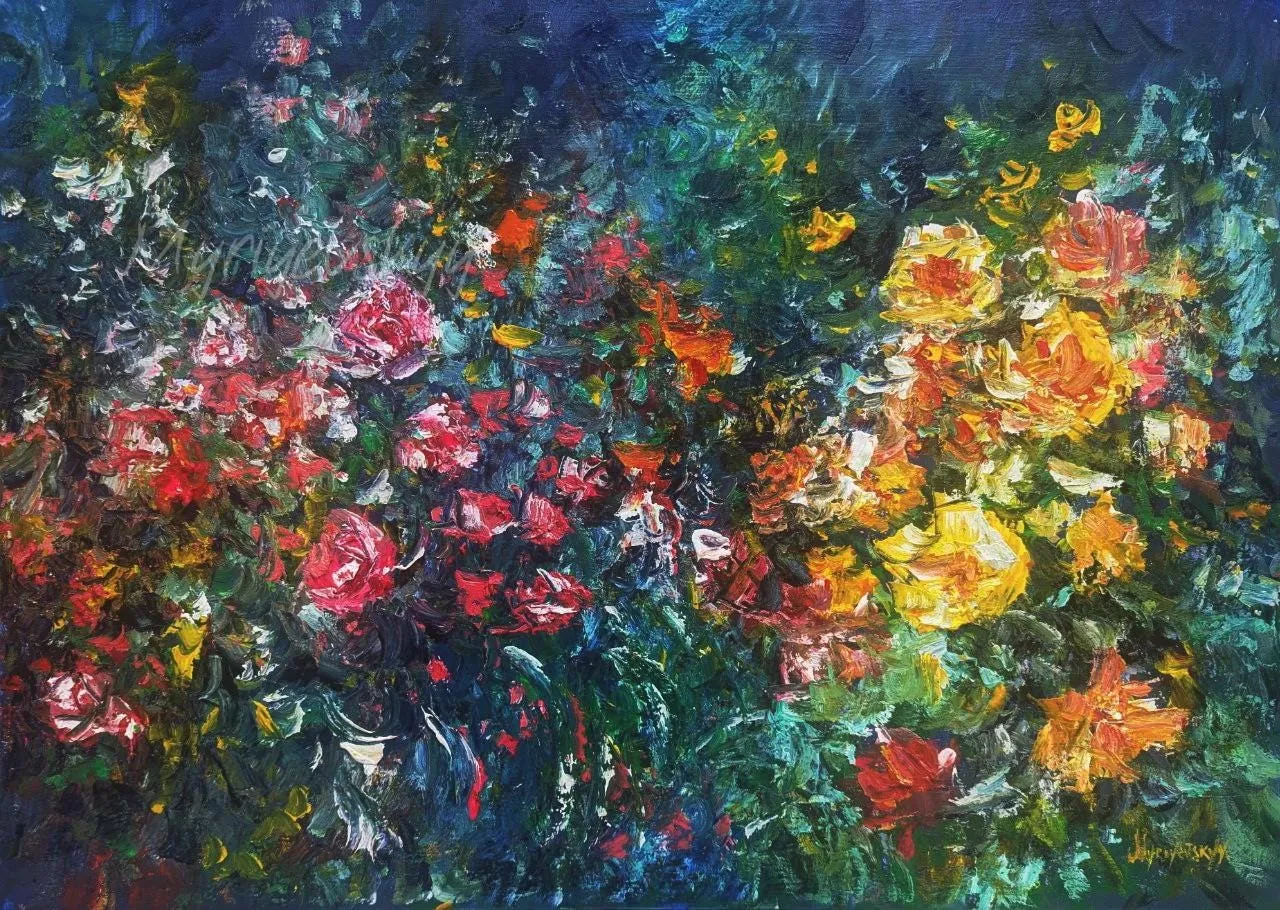
Look across the surface at a low angle. An original oil painting has physical relief — ridges of paint that cast their own shadows — while a print is flat, even when it is printed on canvas. Then check the edges, the back, the price, and whether the seller will give you a certificate naming you.
I sell original paintings, and I also make fine art prints of my own work on request. That puts me in an odd position: I have no interest in pretending prints are bad, and every interest in you knowing which one you are buying. Most of the confusion online is not fraud — it is vague listings. These are the checks that settle it.
1. Look at the surface at an angle
This is the test that decides almost every case. Tilt the painting, or move so the light rakes across it. Real oil paint applied with a palette knife stands off the canvas by a millimetre or more and throws small shadows that move as you move. A print has no relief at all. "Textured" giclée prints on canvas have a uniform, repeating weave — the texture belongs to the material, not to the image, so the bumps do not line up with the brushstrokes.
In a photograph, look for the same thing: shadows inside the paint itself, and highlights on the ridges. A listing that only shows the artwork flat, straight on, and never at an angle is worth a question.
2. Check the edges of the canvas
- On an original, paint usually continues around the sides, sometimes messily. Brush and knife marks run over the edge because the painter was working, not designing a wrap.
- On a canvas print, the sides are either white, or a mirrored/stretched continuation of the image that looks suspiciously tidy.
- On a paper print, the question does not arise — but then it is being sold as paper, which is honest.
3. Turn it over
The back of an original stretched canvas is bare fabric, often with the painter's signature, the title and the date written directly on it, and sometimes a fingerprint of paint where it was handled while wet. A mass-produced print usually has a printed label, a barcode, or nothing at all.
4. Read the words in the listing very literally
The vocabulary is where the ambiguity lives. These phrases do not mean what a hopeful buyer wants them to mean:
| Phrase in a listing | What it actually means |
|---|---|
| Giclée on canvas | A print. A good one, but a print. |
| Hand-embellished | A print with some real paint added on top. |
| Museum quality reproduction | A print. |
| Limited edition of 250 | A print, in an edition of 250. |
| Open edition | A print, with no limit on how many exist. |
| Original oil on canvas, one of one | An original — there is only one. |
None of these are dishonest. But "museum quality" describes the paper or the ink, not the artwork, and an edition number is a count of copies. If a listing never uses the word "original" unqualified, assume it is not one.
5. Let the price tell you
A hand-painted original takes days of work and exists once. A print of the same image can be run a hundred times. When a large "original oil painting" is offered at the price of a poster, the arithmetic does not close — someone is either selling a print, or selling something painted very fast in a workshop by someone whose name is not on the front.
For reference, on this site an original oil on canvas runs from around €135 to over €1,000 depending on size and work, and a fine art print of one of those same paintings is a fraction of that. The gap between the two numbers is the honest signal.
6. Ask for the certificate — and check whose name is on it
A certificate of authenticity that just says "this is an original" is a piece of paper anyone can print. A useful one names the work, the size, the year, the artist, and the owner. Every original that leaves this studio travels with a certificate made out in the buyer's name — and if it is a gift, in the name of the person receiving it. A print does not come with one, and should not.
7. Ask a direct question and read the answer
"Is this a hand-painted original, or a print?" is a question no honest seller minds. What matters is whether the answer is equally direct. A reply that changes the subject to paper weight, museum standards or edition sizes has answered a different question.
I'm not a fancy art collector. I bought this with money I had to save, and didn't know how much I would like it when it arrived. Instead, I love it now that it has arrived.
So is a print a bad buy?
No — as long as it is sold as one and priced as one. A print puts an image you love on your wall for a fraction of the money, and there is nothing wrong with that. What you are not buying is the object: the single physical thing the painter's hand actually touched, the surface that changes as the light moves across the room during the day. That is what an original is for, and it is why it costs what it costs.
Questions people ask
How can I tell if a painting is an original or a print?
Look across the surface at a low angle. An original has physical relief — ridges of paint that cast shadows — while a print is flat even on canvas. Also check whether paint continues around the edges, and whether the back is signed and dated by hand.
Is a giclée an original painting?
No. A giclée is a high-quality inkjet print. It may be beautiful and archival, but it is a reproduction, and it should be priced and described as one.
Does an original painting always come with a certificate of authenticity?
It should. A useful certificate names the work, its size, the year, the artist and the owner. A certificate that only says "original" without naming anything proves very little.
Why are original paintings so much more expensive than prints?
Because an original takes days of work and exists exactly once, while a print of the same image can be produced any number of times. The price gap between the two is the most reliable signal that a seller is being straight with you.
I paint these in my own studio on the Spanish Mediterranean coast. Every painting is a one-of-a-kind original oil on canvas — signed, with a certificate of authenticity in your name, shipped stretched and insured.
See the paintings