How high to hang a painting, and what size to buy
By Volodymyr Myriyevskyy · 7 August 2026 · 5 min read
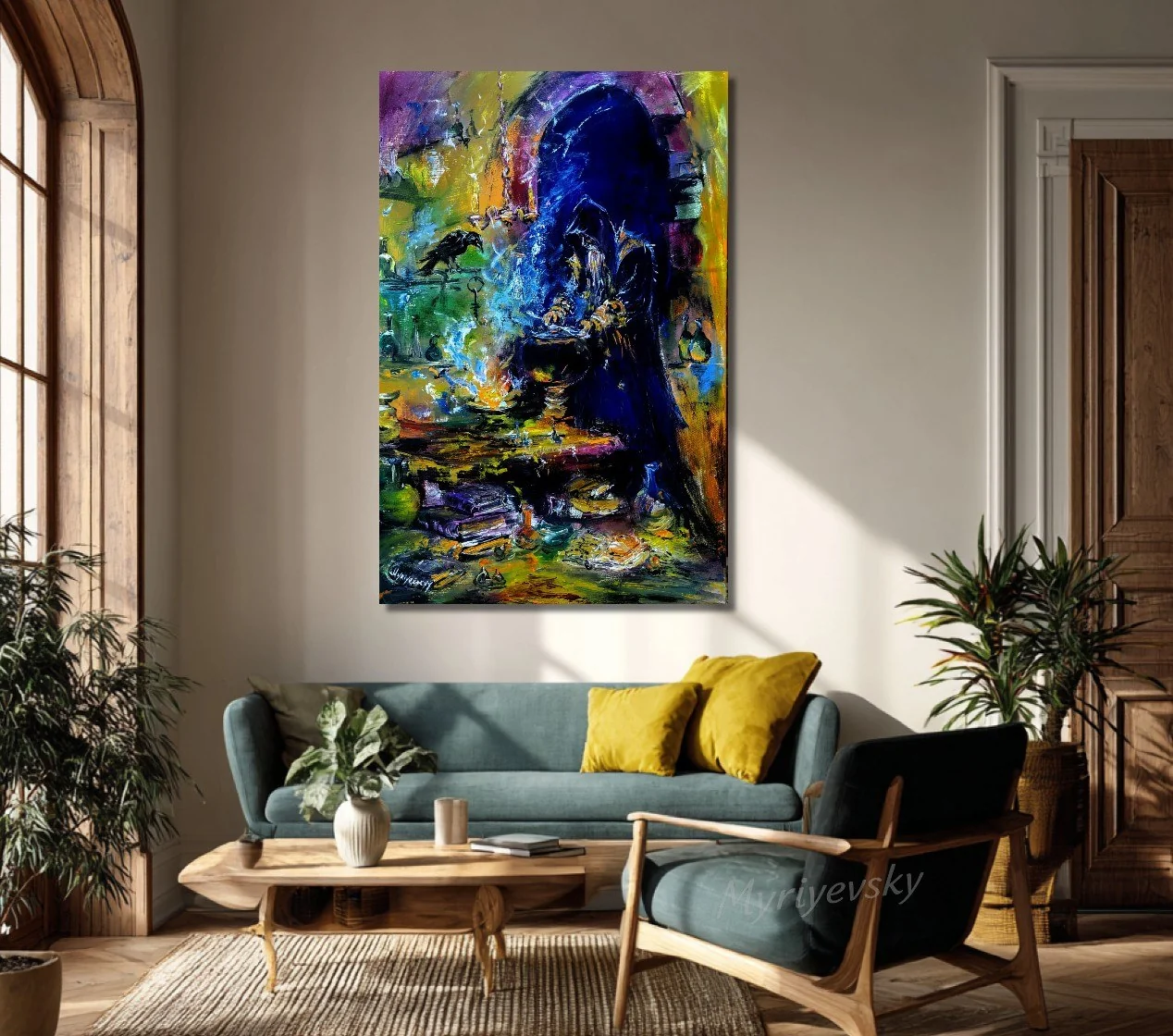
Hang a painting so that its centre sits about 150 cm (59 inches) from the floor — eye level for most people, and the height museums use. Above a sofa, leave 15–25 cm of wall between the sofa back and the frame, and choose a canvas roughly two thirds as wide as the sofa.
Two numbers decide whether a painting looks right on a wall: how high you hang it, and how big it is relative to the furniture underneath. Almost every awkward-looking wall I have seen in a collector's photo is one of those two, and usually the second.
The height: 150 cm to the centre
Measure to the centre of the painting, not to the hook and not to the top edge. 150 cm is the standard gallery hang, and it works because it lands at the eye level of an average standing adult. It is also why a painting hung "where the hook happened to be" so often feels wrong — most people hang 15–20 cm too high.
- Centre at 150 cm from the floor for a normal room where people stand.
- Drop to 140–145 cm in a room where everyone is seated most of the time — a dining room, a reading corner, a bedroom seen from the bed.
- Above furniture, height is decided by the furniture, not by the 150 cm rule: keep 15–25 cm of clear wall between the top of the sofa and the bottom of the frame. Less than 15 cm and the two objects look glued together; more than 30 cm and they stop reading as one group.
Practical trick: hold the painting against the wall, mark the top corners with two strips of masking tape, then step back to the other side of the room and look. Two minutes of tape saves a wall full of holes.
The size: two thirds of the furniture below
The most common mistake in buying art online is buying it too small. A canvas looks enormous in a photograph on a phone and modest on a real wall three metres away. The reliable rule is proportional: the painting should be about 60–75 % as wide as the piece of furniture it hangs over.
| Furniture below | Its width | Painting width that works | Example size |
|---|---|---|---|
| Two-seat sofa | 160 cm | 100–120 cm | one large canvas, or two of 50 cm side by side |
| Three-seat sofa | 200 cm | 120–150 cm | a 120 × 80 cm, or a pair of 60 × 80 cm |
| Sideboard / console | 120 cm | 70–90 cm | a single 70 × 50 cm sits well |
| Bed, headboard width | 160 cm | 100–120 cm | one wide horizontal canvas |
| Fireplace, mantel | 110 cm | 70–90 cm | a vertical 50 × 70 cm reads taller |
Notice that a single 40 × 60 cm canvas — the size a lot of people default to online because it is affordable — is only right over something narrow: a console table, a hallway stretch, a desk. Over a three-seat sofa it will look lost. If the budget points to a small canvas but the wall is wide, hang two or three together with 5–8 cm between them and treat the group as one painting.
How do I know how big it really is?
Every painting page on this site draws the actual canvas, to scale, against a 200 cm sofa and a person 170 cm tall, at the 150 cm centre described above. It is not a decorative illustration — it is drawn from the real measurements of that specific canvas. If a size looks small in that diagram, it will look small on your wall.
The other habit worth acquiring: put masking tape on the wall at the exact dimensions before you buy. Nearly everybody who does this ends up choosing a bigger canvas than they first intended.
It is somehow exactly what I wanted and much better than the photos.
Light, and where not to hang a painting
- Avoid direct sunlight on the canvas. It is the one thing that will genuinely age an oil painting faster — colours shift and the varnish yellows unevenly. North light, or any wall that never takes the afternoon sun directly, is ideal.
- Avoid straight above a working fireplace or a radiator. Heat and soot are worse for a canvas than a cold room.
- Avoid bathrooms and unheated holiday houses. Oil on canvas dislikes swings in humidity far more than it dislikes a steady 60 %.
- A picture light or a spot at roughly 30° from the wall brings out impasto texture. A light straight on flattens it.
That last point matters more with palette-knife work than with a smooth surface. The whole point of a thick, knife-built canvas is that the paint stands off the fabric and casts its own small shadows; light from the side is what shows it.
Questions people ask
How high should a painting be hung?
Centre it at about 150 cm (59 inches) from the floor. Measure to the middle of the painting, not to the hook. In rooms where people are usually seated, 140–145 cm reads better.
How much space should there be between a sofa and a painting?
Between 15 and 25 cm of clear wall between the top of the sofa back and the bottom of the frame. Any closer and the two look stuck together; much further and they stop reading as a group.
What size painting should I buy for above a sofa?
About two thirds of the sofa's width. Over a 200 cm three-seat sofa, that means a canvas of roughly 120–150 cm, or a pair of smaller canvases hung 5–8 cm apart.
Can I hang an oil painting in direct sunlight?
No. Direct sun is the fastest way to age an oil painting: the colours shift and the varnish yellows unevenly. Choose a wall that never takes direct afternoon light.
I paint these in my own studio on the Spanish Mediterranean coast. Every painting is a one-of-a-kind original oil on canvas — signed, with a certificate of authenticity in your name, shipped stretched and insured.
See the paintings